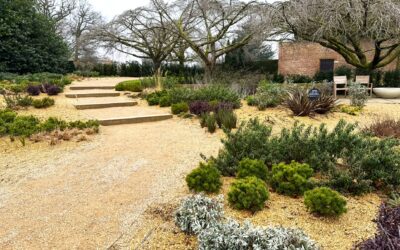
Harrogate’s rise as a spa town began in 1571 when William Slingsby discovered the mineral nature of the waters of the Tewit Well. In 1734 sulphur springs were discovered at Harlow Carr but it was not for another century that the site was developed to become a fashionable spa when medical interest in perceived differences in Harrogate’s waters led to their specialised application. From c.1840 one of the four springs was developed to form the basis of a health spa, with the Harlow Carr Hotel (later known as the Harrogate Arms) and Bath House (exhibition space within the RHS Garden) built in c.1844 by the then owner of the estate, Henry Wright. The hotel and bath house were built in a Victorian Tudor style. People were charged 2s 6d (£0.121 ⁄2) to bathe in the warm waters. The area around the springs and bath house was planted as a relaxing garden for people taking the waters, with shaded seats sheltered by tall trees, shrubs, and walks. At one time as many as six different wells were in use.
Sadly, by the 1940s the Victorian pleasure grounds and woodland scenery had become in large part neglected but new life came to Harlow Carr when purchased by The Northern Horticultural Society. Founded in 1946 for ‘promoting and developing the science, art and practice of horticulture, with special reference to the conditions pertaining to the north of England’, the Society purchased Harlow Carr (mixed woodland, pasture and arable land but excluding the hotel and its immediate grounds) as a trial ground and display garden from the Harrogate Corporation. The intention was to assess the suitability of plants for growing in northern climates.
In 1958 the old Bath House was derelict and became the subject of a fund-raising appeal. It was remodelled to serve as a meeting room, library and offices for many years. The 1980s brought with them a drive to expand the activities offered to the public by the Society and in the gardens. The old Bath House was updated again to include an educational centre and a teaching greenhouse was constructed nearby. The gardens name change to ‘Harlow Carr Botanical Gardens’ emphasised the Society’s commitment to high horticultural standards.
However, in contrast to the gardens, the mid-20th century history of the former Harrogate Arms was mixed. From spa hotel, to private residence to a pub and eventually closed. Separated from its Bath House and pleasure gardens by ownership boundaries and planting, the original identity of this once resplendent spa resort was lost.
The Royal Horticultural Society (with whom the Northern Horticultural society merged in 2001) managed to raise funds to purchase the vacant Harrogate Arms in 2014 and since then the charity have been in discussion with stakeholders to decide how best the building and its surrounds be reincorporated into the wider gardens. Finally, this work is underway, and a new café will be opened in the Harrogate Arms building during 2024 with the landscaping work needed to restore the links between the Bath House and former hotel already well developed.
Article contributed by Fran Pride: https://yorkshiresbestguides.co.uk/project/fran-pride/