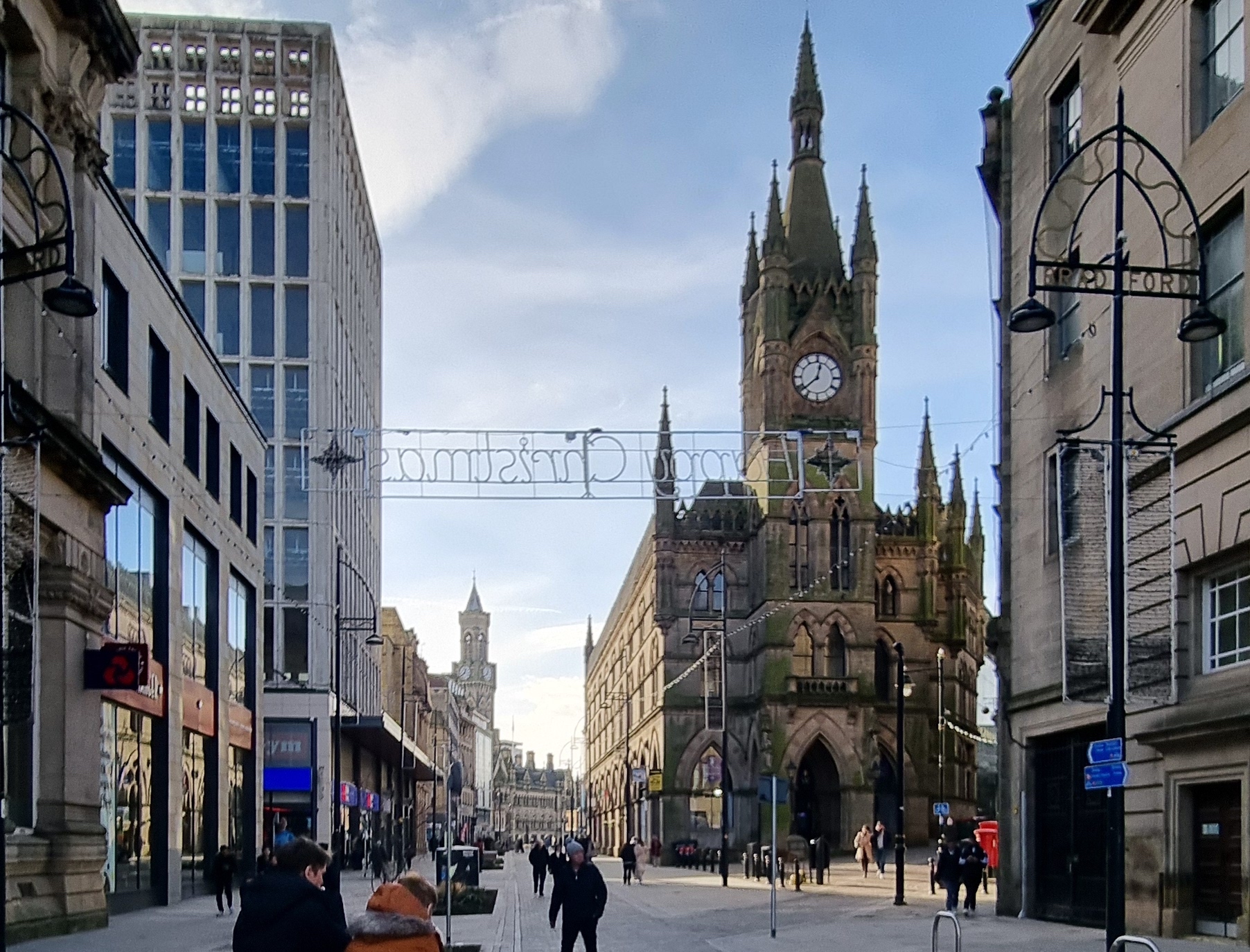
The former Wool Exchange is one of Bradford’s three Grade 1 listed buildings and perhaps the most iconic reminder of the city’s illustrious past. It is now, possibly, the finest Waterstone’s Bookshop in the land.
The Exchange, where wool brokers, spinners, and manufacturers met to strike their deals, was built between 1864 and 1867. It was a strictly ‘members only’ club and strictly ‘men only’ too. Formal dress was compulsory. It is estimated that Bradford processed 2/3 of the countries wool production and it was known as the wool capital of the world. the story goes that there would often be more Rolls Royces parked outside the Exchange than there were in the City of London!
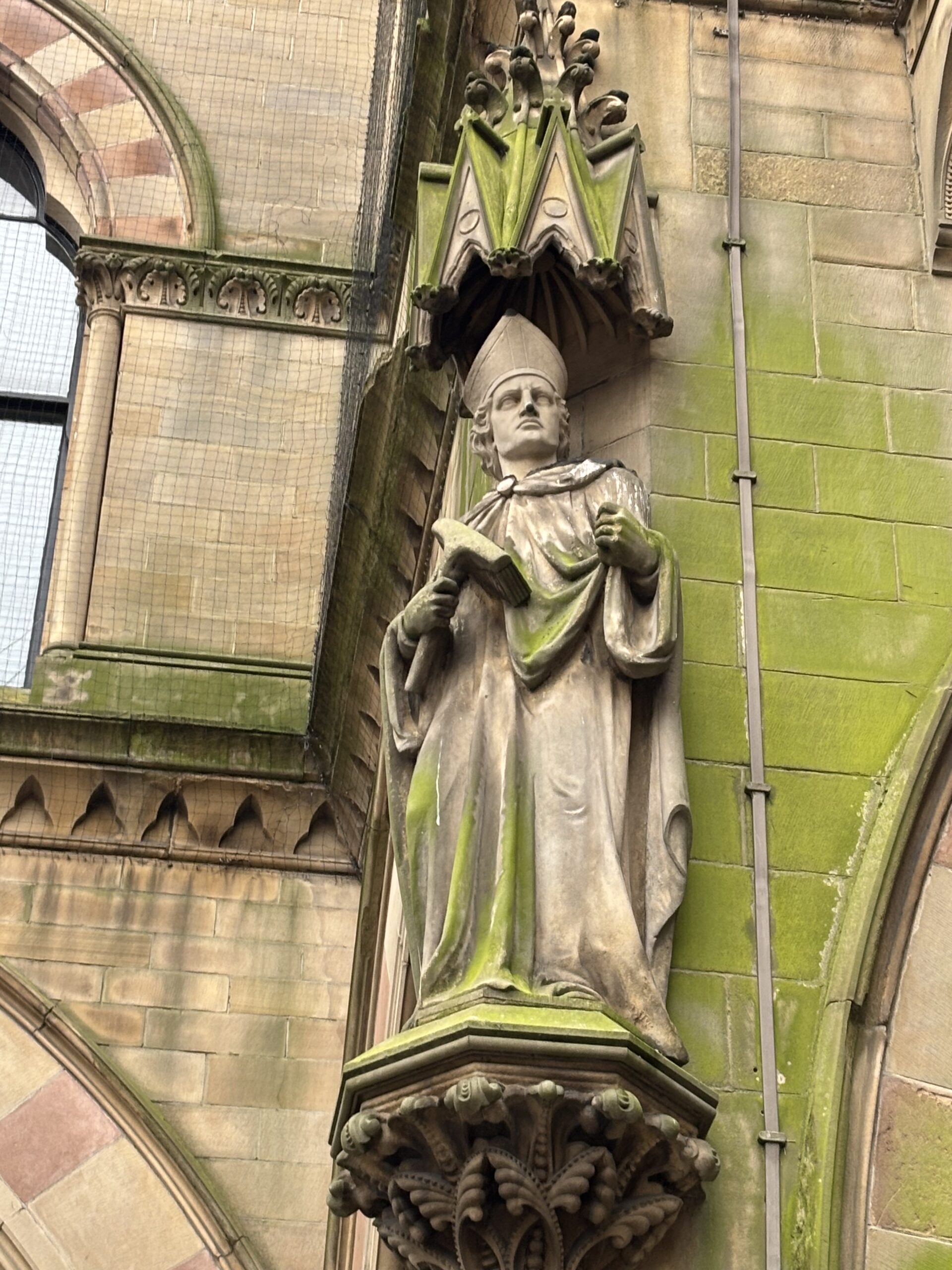
The Exchange is built in the Gothic Revival Style, with pinnacles, parapets and corbelled turrets – a cathedral to the Wool Trade. Beneath the 46m/150ft high clock tower is an elaborate porch guarded by two figures.
To the right is the figure of King Edward 3. In the 14th C, he developed the tradition that the Lord Chancellor should sit on a sack of wool in the House of Lords, symbolizing the great importance of the wool trade to the country’s economy. This continues today.
To the left is the figure of St Blaise, the patron saint of the Wool Workers and the Wool Industry. He is particularly associated with the Wool Combers – crucial in the processing of worsted cloth for which Bradford is famous. Worsted uses the longer fibres of wool and these long fibres need to be carefully combed to all lie flat and in the same direction to create the smooth and high-quality fabric. In his hand you can see St Blaise holds a Wool Comb – a reminder of his horrific martyrdom in 316AD. When Blaise would not renounce his faith, it is said he was beaten with a stick, his flesh ripped with iron wool combs and beheaded.
St Blaise still honoured in the city today with a parade around his Saints day , the 3rd February , which winds its way through the streets to end here beneath his statue.
Article contributed by Sarah Cowling, Yorkshire Blue Badge Guide: https://yorkshiresbestguides.co.uk/project/sarah-cowling/